Gaga Ball Pit Dimensions: Size Guide for Schools, Camps and Parks
Gaga ball pit sizes compared: footprint, octagon geometry, clear space, wall height and how many players fit a 16, 21 or 26 foot pit.
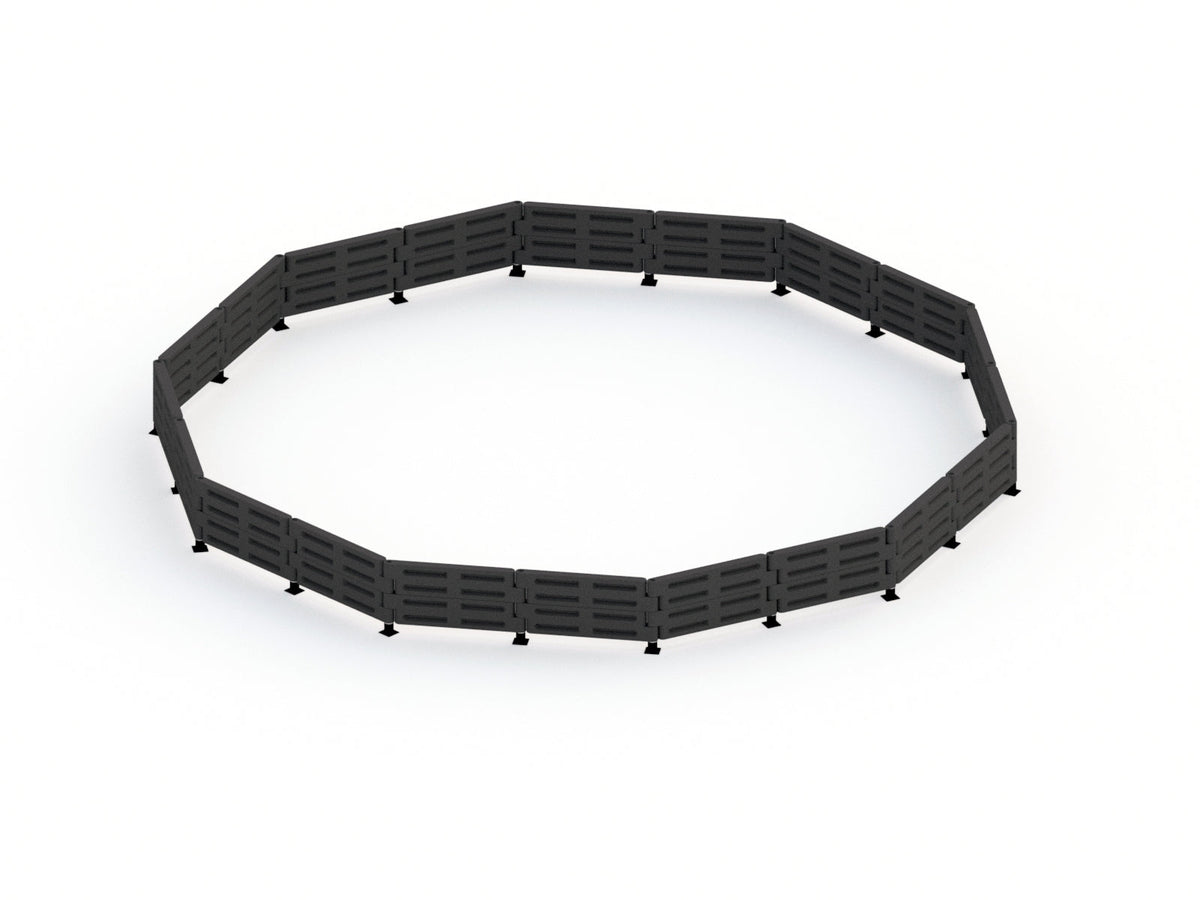
A gaga ball pit is an enclosed, usually eight-sided arena with walls about 2 to 3 feet high, and most commercial pits for schools, camps and parks measure 16 to 26 feet across. The right size depends on how many players you expect at once and how much clear ground you have. Play Grove sells three commercial sizes, a 16, 21 and 26 foot pit, at published prices from $1,235 to $2,090, and this guide covers the dimensions, footprint, wall height and floor for each.
TL;DR
- Commercial gaga ball pits usually come in three sizes: 16, 21 and 26 feet across. Ours are $1,235, $1,710 and $2,090 and ship in about 5 days.
- Plan a clear area equal to the pit size plus about 3 feet on every side: 22 by 22 feet for a 16 foot pit, 27 by 27 for a 21 foot pit and 32 by 32 for a 26 foot pit.
- An octagon is about 8 percent wider corner to corner than flat to flat, so a pit 21 feet across the flats is about 22.7 feet across the corners.
- As a planning rule of thumb, a 16 foot pit fits 6 to 10 players, a 21 foot pit 10 to 14 and a 26 foot pit 14 to 20.
- Keep the pit and its clear area outside the use zones of swings, slides and other play equipment, which start at 6 feet for stationary equipment under CPSC guidelines.

What is a gaga ball pit?
A gaga ball pit is a low-walled enclosure, usually an octagon or hexagon, built to keep the ball in play during a game of gaga ball. Players stand inside, hit the ball with an open hand and bank shots off the walls. The pit has three parts that matter when you plan one:
- The walls. Eight panels (on an octagon) that stop the ball and define the playing area. Wall height decides how easily players can step in and see over.
- The entry. Players climb over, step through a lower section or use a gate, depending on the design.
- The floor. The surface inside the walls, which takes more wear than any other part of the pit.
If you are new to the game itself, our gaga ball rules guide covers how a round works.
Standard gaga ball pit sizes
There is no legal or industry standard that fixes the size of a gaga ball pit, but commercial pits for schools, camps and parks usually land on 16, 21 or 26 feet across. Smaller pits are mostly backyard builds. The right size comes down to how many players will be in the pit at the same time.
| Pit size | Planning headcount | Clear area to plan | Price | Lead time |
|---|---|---|---|---|
| 16 foot | 6 to 10 players | 22 by 22 feet | $1,235 (list $1,300) | About 5 days |
| 21 foot | 10 to 14 players | 27 by 27 feet | $1,710 (list $1,800) | About 5 days |
| 26 foot | 14 to 20 players | 32 by 32 feet | $2,090 (list $2,200) | About 5 days |
Headcounts are planning rules of thumb for continuous drop-in play, not rated capacities. Freight is quoted to your ZIP code before anything ships.
How big is a gaga pit, measured the right way?
A gaga pit's listed size is its width across the octagon, and you need to know whether that width is measured flat to flat or corner to corner, because the two differ by about 8 percent. On a regular octagon, the corner to corner distance is the flat to flat distance multiplied by 1.082. Always confirm which one the spec sheet uses before you mark out the site.
Here is the geometry for each size, assuming the listed size is the flat to flat width:
| Pit size (flat to flat) | Each wall panel | Corner to corner | Wall perimeter | Floor area inside |
|---|---|---|---|---|
| 16 feet | About 6 ft 8 in | About 17.3 feet | About 53 feet | About 212 sq ft |
| 21 feet | About 8 ft 8 in | About 22.7 feet | About 70 feet | About 365 sq ft |
| 26 feet | About 10 ft 9 in | About 28.1 feet | About 86 feet | About 560 sq ft |
The floor area grows much faster than the width. A 26 foot pit is only 10 feet wider than a 16 foot pit, but it has more than two and a half times the floor.
Worked example: marking out a 21 foot pit
Drive a stake at the center of the site. A regular octagon 21 feet across the flats has corners about 11.4 feet from the center, so tie a string to the stake, mark a circle at 11.4 feet and place the eight corners on that circle, each one about 8 feet 8 inches from the next. Then mark a second square 27 by 27 feet around the whole thing. That outer square is the area you clear, level and keep free of other equipment.
How much space do you need for a gaga ball pit?
You need the pit size plus about 3 feet of clear ground on every side, which works out to 22 by 22 feet for a 16 foot pit, 27 by 27 feet for a 21 foot pit and 32 by 32 feet for a 26 foot pit. That ring is for the entry, the waiting line and supervision.
The bigger issue on a playground is the other equipment. The CPSC Public Playground Safety Handbook calls for a use zone that extends at least 6 feet in all directions around stationary play equipment, and swings and slide exits need more. Keep the pit and its clear area out of those zones entirely. Our how to plan a playground layout guide walks through measuring use zones before you place anything.
Site checklist before you order
- Clear area measured at full size (pit plus 3 feet per side), not just the pit.
- Ground that is level or can be leveled, with a way for water to drain out of the pit.
- Outside every swing, slide and structure use zone.
- Within sight of where staff or parents normally stand.
- An accessible route from the main path to the pit entry.

How many kids fit in a gaga ball pit?
A 16 foot gaga ball pit fits about 6 to 10 players at once, a 21 foot pit about 10 to 14 and a 26 foot pit about 14 to 20, as planning numbers for continuous play. At the top of each range, every player has roughly 21 to 28 square feet of floor, about the space of a 5 by 5 foot square. Below that, players start colliding more than they play.
For a recess or camp rotation, plan around your peak headcount, not your average. If 40 kids come out to recess and you expect a third of them to want gaga at once, that is about 13 players, which points to the 21 foot pit.
What wall height is best for a gaga pit?
Most gaga pit walls are about 2 to 3 feet high, tall enough to keep the ball in play and low enough for kids to step in and for adults to see over. Wall height on a commercial pit is set by the manufacturer, so check the spec sheet for the model you are ordering. For comparison, the widely shared KABOOM! DIY gaga pit plan stacks three 2x12 boards, which makes a wall just under 34 inches tall, and uses a shorter panel on one side as an easier entry for small children.
- Taller walls keep more shots in play.
- Lower walls are easier for preschoolers to step over and easier for staff to supervise.
- A lower entry panel or a gap with a gate helps younger players and anyone using a mobility aid.
What goes inside a gaga ball pit?
The floor of a gaga ball pit is usually engineered wood fiber, rubber mulch, packed dirt, sand or a hard surface like asphalt, and the right choice depends on drainage, budget and what surrounds the pit.
- Engineered wood fiber or rubber mulch: softer on falls, but needs raking and topping up, and needs drainage underneath.
- Packed dirt or sand: cheap and common at camps, but turns muddy after rain and wears into ruts.
- Asphalt or concrete: lasts longest and drains well if sloped, but is less forgiving on falls.
If the pit sits inside a larger surfaced play area, the surfacing there still has to meet the requirements of the equipment around it, including impact attenuation tested to ASTM F1292, and engineered wood fiber should meet ASTM F2075. Play Grove does not stock surfacing, but we quote and specify it with the project. Our playground surfacing options compared guide breaks down cost and upkeep for each.
New England notes
Freeze and thaw is the main issue in Connecticut, Massachusetts and the rest of New England. Loose floors heave and settle over winter, so rake the pit level each spring before play starts. Give water somewhere to go, either a gravel base under a loose fill or a slight slope out an open side.
Is a gaga ball pit accessible?
A gaga ball pit can be made accessible by giving it an accessible route to the entry and a floor that a wheelchair or walker can cross. If the pit is part of a playground, plan it the way the 2010 ADA Standards for Accessible Design treat play areas: a firm, stable route from the main path to the pit, and an entry that does not require climbing over the wall. Loose fill like wood fiber can meet that standard only when it is installed and maintained for it, so a hard approach and a firm floor are the simplest path.
Which gaga ball pit size should you buy?
Buy the size that fits your peak headcount and your clear area, and go one size up if you are unsure, since an overcrowded pit is the most common complaint. By site type:
- Elementary school recess: the 21 or 26 foot pit, so a rotating group is not crowded.
- Summer camp or after school program: the 21 foot pit covers most group sizes without taking over the field.
- Church youth group: the 16 or 21 foot pit fits a fellowship lawn or a parking lot corner.
- Municipal park: the 26 foot pit handles drop-in crowds and family play.
- HOA or small play area: the 16 foot pit gives you the feature without eating the lawn.
- Daycare or preschool: the 16 foot pit, with a lower entry and close supervision.

Gaga ball pit prices and ordering
Our gaga ball pits cost $1,235 for the 16 foot, $1,710 for the 21 foot and $2,090 for the 26 foot pit, and the prices on our gaga ball pits for sale page are the real prices, not placeholders. Each pit has a model number (FUN-00016, FUN-00021 and FUN-00026) you can put on a purchase order or grant budget. Purchase orders and tax-exempt billing are accepted, and freight is quoted to your ZIP code before anything ships.
Weighing whether volunteers could build one instead? Our gaga ball pit kit vs DIY guide runs the lumber math and the real cost of a homemade pit.
Frequently asked questions
What is the standard size of a gaga ball pit?
There is no official standard size. Commercial pits for schools, camps and parks usually run 16, 21 or 26 feet across, and smaller pits are mostly backyard builds. Pick the size by your peak headcount: about 6 to 10 players for 16 feet, 10 to 14 for 21 feet and 14 to 20 for 26 feet.
How much space do I need for a gaga ball pit?
Plan the pit size plus about 3 feet on every side. That is a 22 by 22 foot clear area for a 16 foot pit, 27 by 27 for a 21 foot pit and 32 by 32 for a 26 foot pit. Keep that whole area outside the use zones of swings, slides and other playground equipment.
How tall are gaga ball pit walls?
Most gaga pit walls are about 2 to 3 feet high. A common DIY plan stacks three 2x12 boards for a wall just under 34 inches. On a commercial pit the manufacturer sets the height, so check the spec sheet, and look for a lower entry panel or gate if younger children will play.
Is a gaga pit measured across the flats or the corners?
It depends on the manufacturer, so confirm it on the spec sheet. The difference matters: a regular octagon is about 8 percent wider corner to corner than flat to flat. A pit that is 21 feet across the flats is about 22.7 feet across the corners, which changes how much ground you clear.
Can a gaga ball pit stay outside all year?
Yes, commercial pits are built for permanent outdoor installation. Plan drainage so the floor does not hold water, clear snow and ice before anyone plays, and rake loose floors level each spring after freeze and thaw. Add the walls and connections to your regular playground inspection route.
Does a gaga ball pit need a foundation?
Our product pages do not list a foundation requirement. What every pit does need is a level, well-drained site and a floor surface chosen for your use. Ask us before you order and we will confirm the installation details for the exact size you are buying and your site conditions.
Get the right pit on your site
Measure your clear area, count your peak group and pick the size that fits both. Then browse the three pits on our gaga ball pits page, or request a quote with your ZIP code and site details and we will send a firm price with freight, plus surfacing if you want it included.
- CPSC Public Playground Safety Handbook, Publication 325
- United States Access Board, guide to the play areas requirements
- ASTM F1487, safety performance specification for playground equipment
- IPEMA product certification register
Cost figures are PlayGrove planning estimates based on current manufacturer pricing and installed project costs in the United States. They are budgeting ranges, not quotes. Standards are revised periodically, so check the current revision before specifying.
Turn this into a number you can take to a board
Send the dimensions, the age ranges and the ZIP code. You get one firm all-in proposal covering equipment, freight, surfacing and installation, written to be read by people who were not in the meeting.
A quote costs nothing and commits you to nothing. If you are early and just need a credible number for a grant application, that is a perfectly good reason to ask.