Gaga Ball Rules: How to Play Gaga Ball
The core gaga ball rules, what gets a player out, the most common house rules, and the game's roots in Israel and US summer camps.
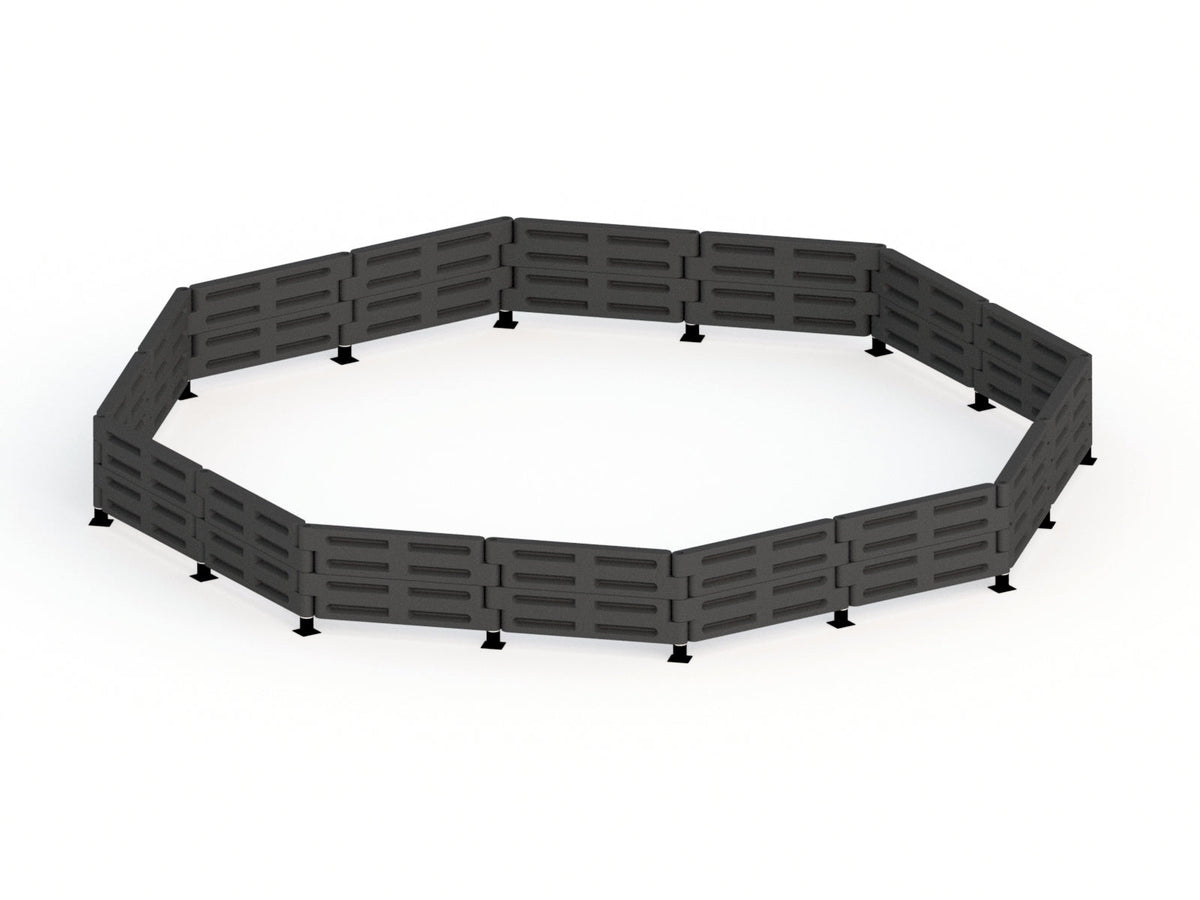
Gaga ball rules are simple: everyone stands inside a walled pit, players hit a soft ball with an open hand, and anyone touched by the ball at or below the knee is out. The last player left in the pit wins. The details, like the "ga, ga, go" bounce count at the start and what happens when the ball flies over the wall, change a little from camp to camp, so below are the core rules most programs use plus the house rules you are most likely to run into.
TL;DR
- Gaga ball is a dodgeball variant played inside an enclosed pit, usually an octagon, where players strike the ball with an open hand instead of throwing it at each other.
- A round starts with every player touching the wall while the ball bounces three times, and players call "ga" on each bounce (or "ga, ga, go") before the ball is live.
- You are out if the ball touches you at or below the knee, if you hit the ball out of the pit, or if your hit is caught on the fly.
- No double hits: a player cannot touch the ball twice in a row unless it hits a wall or another player in between.
- Most accounts trace the game to Israel, where "ga ga" is usually translated from Hebrew as "touch touch," and credit Israeli counselors at Jewish summer camps with bringing it to the US.

What is gaga ball?
Gaga ball is a fast, low-contact version of dodgeball played inside a fenced pit, where players knock a ball around with their hands and try to hit opponents below the knee. Nobody throws the ball at anyone. Everyone stays inside the walls, the ball stays low, and the game moves from one player to the next in seconds.
The pit does most of the work. Low walls, usually around 2 to 3 feet high, keep the ball in play, and most pits are octagons or hexagons.
Where did gaga ball originate?
Gaga ball most likely started in Israel and came to the United States through Jewish summer camps, though nobody has documented a single moment of invention. The name is usually written in Hebrew as גע גע and translated as "touch touch."
Israeli counselors working at Jewish summer camps in North America get most of the credit for spreading it here. Moment Magazine reports the game is most commonly believed to have reached the US in the late 1960s to early 1970s, and that it was played mostly in Jewish camps and community centers at first, with rules passed along by word of mouth and pits built by hand.
From there it moved into public schools, scouting camps, church programs and parks. By July 2012 the New York Times was describing gaga as "solidly mainstream," with kids teaching the game to their parents, and a dedicated gaga facility had opened in Manhattan the year before, according to the history summarized on Wikipedia.
Who invented gaga ball?
No one has a confirmed claim to inventing gaga ball. The best-known individual claim comes from Steve Steinberg, a Baltimore native who told a Tablet reporter he came up with the game in 1975 as a teenage counselor at Camp Milldale. It is one person's account and conflicts with reports of the game being played in Israel and at US camps before then, so the safest answer is that gaga has no single inventor on record.
How do you play gaga ball?
You play gaga ball by starting with a hand on the pit wall, waiting for the ball to bounce three times, then hitting it with an open hand at other players' legs until only one player is left. Here is a full round, step by step.
1. Start on the wall
Every player steps into the pit and touches the wall with one hand. Nobody leaves the wall until the ball is live.
2. Put the ball in
A referee, a counselor or the winner of the last round tosses the ball into the center of the pit. Players call "ga" on each of the first three bounces, or "ga, ga, go" in some groups. After the third bounce the ball is live and players can come off the wall.
3. Hit the ball low
Players strike the ball with an open hand, aiming at opponents' feet, ankles and shins. Banking the ball off a wall is legal and often the best shot.
4. Get out and wait
A player who is hit at or below the knee leaves the pit right away and waits outside the wall. In a standard game there is no coming back during the round, though several house rules change that (see the variations below).
5. Last player standing wins
Play continues until one player is left. That player wins and, in many groups, serves the next round.
Gaga ball rules quick reference
The rules most programs agree on, with the most common way each one gets changed. Pick one version and post it at the pit.
| Rule | Standard version | Common variation |
|---|---|---|
| Start | Hand on the wall, three bounces, "ga, ga, go" | Back against the wall, or a two-bounce start |
| Out line | At or below the knee | Ankle for older players, waist for young children |
| Hitting | Open hand only, no fists, no kicking | Closed-hand hits allowed, still no punching |
| Double hits | Not allowed unless the ball touches a wall or player in between | Allowed once only two players remain |
| Catching | Not allowed; if a hit is caught on the fly, the hitter is out | Catch on the fly puts the hitter out and the catcher stays in |
| Ball leaves the pit | Last player to touch it is out | No out if it bounced off a wall or the ground first |
| Wall climbing | Not allowed to use the wall to jump | Allowed in some camps ("spidering") |
| Ending | Last player in the pit wins | Second ball or a countdown when the round stalls |

What gets you out in gaga ball?
You are out in gaga ball when the ball touches you at or below the knee, when you send the ball out of the pit, or when you break a hitting rule. The full list:
- Hit at or below the knee. Contact on the knee, shin, ankle or foot counts. Contact above the knee does not.
- Hitting yourself. If you hit the ball and it comes off your own hand into your leg at or below the knee, you are out.
- Ball over the wall. The last player to touch a ball that leaves the pit is out.
- Caught on the fly. If another player catches your hit before it bounces, you are out. Most groups do not let players catch on purpose at all.
- Double hit. Touching the ball twice in a row without it hitting a wall or another player first.
- Leaving the wall early. Taking your hand off the wall before the third bounce.
- Turtling. Deliberately dropping a knee or lower leg to the ground to block a low ball. An accidental touch is usually not called.
- Using the wall to jump. In standard rules, climbing or pushing off the wall to dodge is an out.
Common gaga ball variations and house rules
Gaga ball has no single rulebook every program follows, so most camps and schools add a few house rules to fit their group. The ones you will see most often:
- Raised out line. For younger children, some programs move the out line up to the waist so the game is less about lightning-fast foot reflexes.
- Team gaga. Players split into two sides and can only be put out by the other team, which keeps big groups engaged.
- Medic gaga. A designated medic on each team can tag eliminated teammates back in until the medic is put out.
- Cover rule. An eliminated player comes back in if the player who got them out is eliminated later in the same round.
- Two-ball gaga. A second ball goes in, usually when the round is down to two or three players and nobody can finish it.
None of these is more "official" than another. The rule that matters most is consistency. If you run the waist line for K to 2 and the knee line for grades 3 to 5, put both on the sign.
Is gaga ball a sport?
Gaga ball is an organized recreational game rather than a governed sport, played in camp leagues, school intramurals, rec department programs and local tournaments. Competitive play was reported in Australia in the 1980s, and Manhattan had a dedicated gaga facility by 2011.
There is no single rulebook every program follows, which is why rules differ from camp to camp.
How is gaga ball different from dodgeball?
The biggest difference is that in gaga ball nobody throws the ball at another player; you strike a ball that is already moving, with an open hand, and only contact at or below the knee counts. In dodgeball, players throw the ball directly at opponents and hits anywhere on the body usually count.
Because the ball stays low, head and face shots are rare compared with dodgeball, and rounds are short enough that eliminated players are back in within a few minutes.
How many players can play gaga ball at once?
The number of players depends on pit size: as a planning rule of thumb, about 6 to 10 fit a 16 foot pit, 10 to 14 fit a 21 foot pit and 14 to 20 fit a 26 foot pit. Those are not rated capacities, and an overcrowded pit is where most collisions happen. For bigger groups, run a line outside the wall and start a new round every few minutes. Our gaga ball pit dimensions guide covers footprint and clear space for each size.

Gaga ball safety rules for schools, camps and churches
Gaga ball is generally gentler than dodgeball because players strike the ball low rather than throwing it at each other, but a few standard rules keep it that way:
- Use a soft ball. A soft rubber, foam or playground ball around 8 to 10 inches works well. Avoid hard or overinflated balls.
- Open hands only. No fists, no kicks, no throwing.
- No diving or sliding. Especially on a hard floor or packed dirt.
- Cap the headcount. Set a maximum number of players for your pit size and run a line outside the wall.
- Separate ages. Run younger and older kids in different rounds, or use the raised out line when they play together.
In New England, spring is when a pit needs the most attention, since freeze and thaw can heave a packed floor. Rake the floor level and clear standing water before the first recess of the season.
How to post gaga ball rules at your pit
A posted sign settles most arguments before they start. Keep it short enough for a second grader and put it by the entry. A version you can use as written:
- Start with one hand on the wall. Wait for three bounces: "ga, ga, go."
- Hit the ball with an open hand only. No kicking, no catching, no throwing.
- Hit at or below the knee: you are out.
- Hit the ball over the wall: you are out.
- No hitting the ball twice in a row.
- No climbing or jumping off the wall.
- Last player in wins and serves the next round.

Frequently asked questions
Who invented gaga ball?
No one has a confirmed claim. Most accounts trace gaga to Israel and credit Israeli counselors at Jewish summer camps with bringing it to the US, likely by the late 1960s or early 1970s. A Baltimore man, Steve Steinberg, has said he invented it at Camp Milldale in 1975, but that is one person's account and conflicts with earlier reports of the game.
Is gaga ball a sport?
Gaga ball is an organized recreational game rather than a governed sport. It is played in camp leagues, school intramurals, rec programs and local tournaments, but there is no single rulebook every program follows. That is why rules like the out line, catching and wall climbing vary between camps and schools.
What kind of ball do you use for gaga ball?
Most programs use a soft rubber, foam or playground ball around 8 to 10 inches across. Foam dodgeballs and rubber kickballs are both common choices. Skip hard or overinflated balls, since nearly every hit lands on a shin, ankle or foot.
Can you catch the ball in gaga ball?
Not in most versions. Players are not allowed to catch, hold or throw the ball. If a player's hit is caught on the fly before it bounces, the player who hit it is out, which is why some groups treat a clean catch as a legal way to put out the hitter.
How long does a round of gaga ball last?
Most rounds last under five minutes, and many end in one or two. When a round stalls with two or three careful players left, groups add a second ball or start a short countdown, often 20 seconds, so the next round can begin.
Can you play gaga ball without a pit?
Yes. Gyms often play inside a ring of folding tables or portable wall panels, or tape a boundary on the floor. A pit with solid walls works much better, because the walls keep the ball in play and let players bank shots off them.
Bring gaga ball to your site
A gaga pit gets more kids moving at once, which is why it is now a standard request on school playground equipment projects and for church playgrounds running youth group and VBS. If your group is ready for a permanent pit, browse our commercial gaga ball pits in 16, 21 and 26 foot sizes, priced from $1,235 to $2,090 and shipping in about 5 days. Thinking about having volunteers build one instead? Read our gaga ball pit kit vs DIY comparison first. For a firm number with freight to your ZIP code, request a quote.
- CPSC Public Playground Safety Handbook, Publication 325
- United States Access Board, guide to the play areas requirements
- ASTM F1487, safety performance specification for playground equipment
- IPEMA product certification register
Cost figures are PlayGrove planning estimates based on current manufacturer pricing and installed project costs in the United States. They are budgeting ranges, not quotes. Standards are revised periodically, so check the current revision before specifying.
Turn this into a number you can take to a board
Send the dimensions, the age ranges and the ZIP code. You get one firm all-in proposal covering equipment, freight, surfacing and installation, written to be read by people who were not in the meeting.
A quote costs nothing and commits you to nothing. If you are early and just need a credible number for a grant application, that is a perfectly good reason to ask.