Gaga Ball Pit Kit vs DIY Build: Cost, Lumber and Time
Should you buy a gaga ball pit kit or build one? Lumber math, real DIY cost, build time and liability, compared with kit prices.
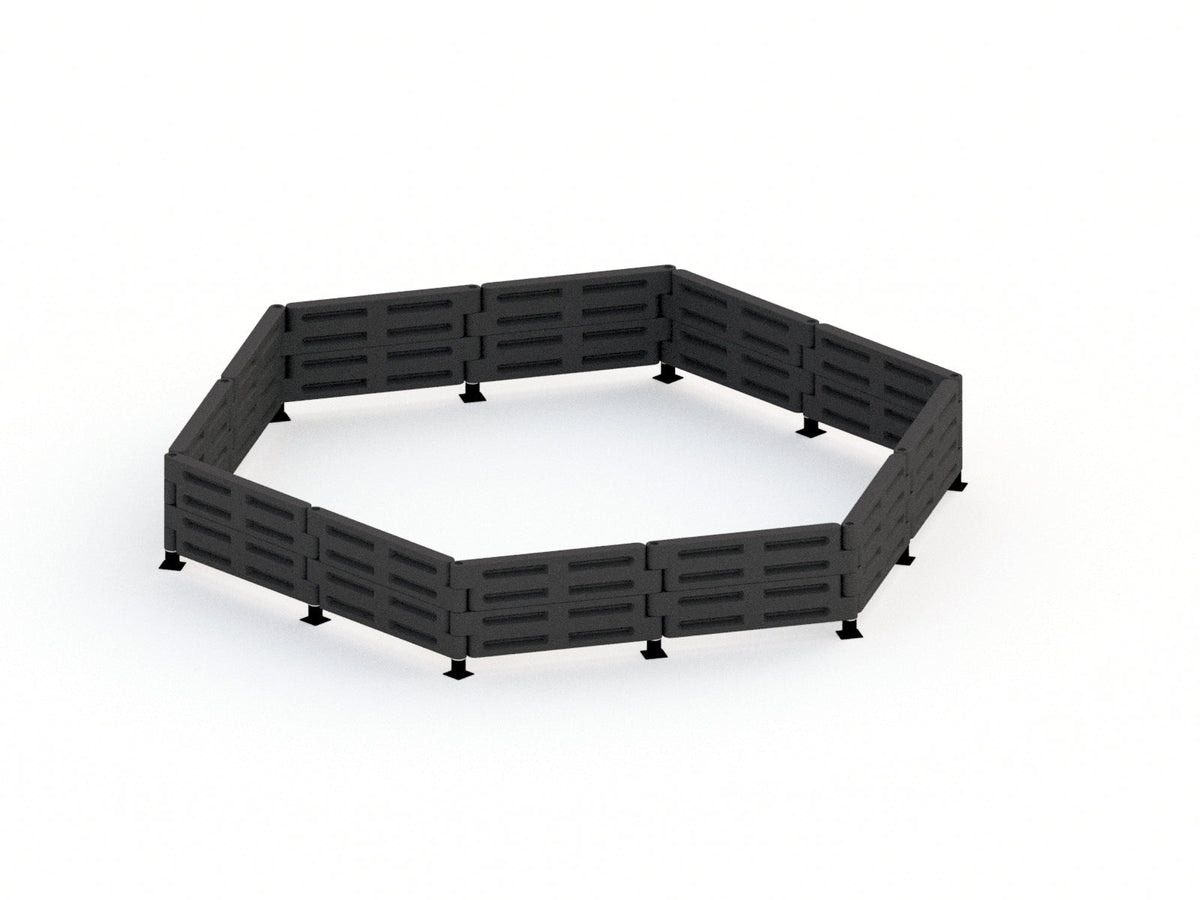
A gaga ball pit kit costs more up front, $1,235 to $2,090 for our 16 to 26 foot commercial pits, but it arrives in about 5 days as a documented, bolted wall system with a model number. A DIY gaga ball pit can be built for a few hundred dollars in lumber, but it takes a crew most of a day plus prep, and you own the design and the liability. For a backyard or scout project, building it yourself can make sense; for a school, church or park, a kit is usually the better buy.
TL;DR
- A common DIY plan for an eight-sided pit about 19 feet across uses 12 pressure-treated 2x12x16 boards, 6 1x6x12 boards, 16 three-inch hinges and 2 pounds of 2-inch deck screws.
- At October 2026 Home Depot online prices for ground-contact 2x12s, wall lumber alone runs about $348 to $561 for a 16 foot pit and $641 to $712 for a 21 foot pit, before hardware, sealant and the floor.
- KABOOM! rates its DIY pit build at 6 hours for a crew of 4 volunteers, which is about 24 volunteer hours not counting shopping, cutting prep and site work.
- Our commercial gaga ball pit kits cost $1,235 (16 foot), $1,710 (21 foot) and $2,090 (26 foot), ship in about 5 days and carry a model number for purchase orders and grants.
- DIY fits backyards, scout and shop-class projects; kits fit schools, churches, parks and anyone whose insurer or risk manager wants a purchased product.

Gaga ball pit kit vs DIY: how do they compare?
A kit trades money for time, paperwork and predictability, while a DIY build trades volunteer labor and liability for a lower materials bill. Here is the side-by-side.
| DIY build | Kit | |
|---|---|---|
| Upfront cost | Wall lumber about $348 to $873 depending on size, plus hardware, sealant and tools | $1,235 (16 foot), $1,710 (21 foot), $2,090 (26 foot), plus freight |
| Labor | About 24 volunteer hours for the build, plus shopping and cutting | Assembly of a bolted wall system |
| Time to play | Often two or more work sessions from plan to first game | About 5 days to ship, then assembly |
| Tools | Miter saw, drill, level, tamp, tape, square | Whatever the assembly instructions call for, no cutting |
| Hidden costs | Cutting waste, rework, replacement boards, resealing | Freight to your ZIP, floor surface |
| Paperwork | None, you are the designer | Model number for POs, grants and bids |
| Upkeep | Splinter checks, resealing, board and hinge replacement | Bolt and wall checks on your inspection route |
| Liability | Your design, your responsibility | A purchased product with a spec sheet and a supplier to call |
How do you build a gaga ball pit?
You build a gaga ball pit by cutting eight wall sections with 22.5 degree bevels on each end, strapping each section together, hinging the sections into an octagon and leveling a floor inside. The most widely shared plan comes from KABOOM!, which rates it "complex" and estimates 6 hours with 4 volunteers. Each wall section is three 2x12 boards stacked on edge, so the wall comes out just under 34 inches tall, and each section is 8 feet long, which makes a pit about 19.3 feet across the flats.
Materials
- 12 pressure-treated 2x12 boards, 16 feet long
- 6 pressure-treated 1x6 boards, 12 feet long (for the vertical straps)
- 16 three-inch hinges (two per corner)
- 2 pounds of 2-inch deck screws
Cut list
- 24 pieces of 2x12 at 96 inches, both ends beveled at 22.5 degrees (cut each 16 foot board in half)
- 21 straps of 1x6 for the seven full sections, three per section
- 3 shorter 1x6 straps at 24 inches for the entry section
One note on the published plan: its cutting steps produce 36 inch straps while its build list calls for 34 inch straps. Measure the actual height of your three stacked boards before you cut, and size the straps to that.
Build steps
- Clear grass and level the pit area.
- Assemble seven full sections, each with three 2x12s held together by three 1x6 straps: one in the center and one about 10 inches from each end.
- Assemble the eighth section with only two 2x12s and the 24 inch straps. This lower panel is the entry for smaller children.
- Stand the sections up and hinge them into an octagon, one hinge on the top board and one on the bottom board at each corner.
- Measure across the flats in four directions. If the numbers do not match, the pit is egg-shaped; adjust before you set the floor.
- Prepare the floor: asphalt, concrete, limestone screenings, decomposed granite, sand or packed dirt.
How much lumber do you need for a DIY gaga ball pit?
You need 24 wall boards for any three-board-high octagon, and the size of the pit decides how long those boards must be. Each wall panel on a regular octagon is about 0.414 times the width across the flats, so the panel length, and how many panels you can get from one board, changes with every size.
| Pit width (flats) | Panel length | Boards to buy | Wall lumber cost |
|---|---|---|---|
| 16 feet | About 79.5 inches | 12 boards, 2x12x16 (two panels each) | About $348 to $561 |
| 19.3 feet (KABOOM plan) | 96 inches | 12 boards, 2x12x16 (two panels each) | About $348 to $561 |
| 21 feet | About 104.5 inches | 24 boards, 2x12x10 (one panel each) | About $641 to $712 |
| 26 feet | About 129 inches | 24 boards, 2x12x12 (one panel each) | About $786 to $873 |
Costs use Home Depot online prices for ground-contact pressure-treated 2x12s in October 2026, from the bulk price for 16 or more boards to the single-board price. Local prices vary, so get a quote from your own lumber yard before you budget.
Worked example: matching a 21 foot pit
A 21 foot pit needs panels about 104.5 inches long. That is too long to get two from a 16 foot board (192 inches), so you would waste about 87 inches per board. Ten foot boards (120 inches) leave about 15 inches of waste each, and 24 of them cost about $641 to $712. Then add 24 straps, 16 heavy hinges, screws, sealant and a floor. The materials bill alone gets closer to the price of a 16' Commercial GaGa Ball Pit than most volunteers expect, before anyone has picked up a saw.

How much does it cost to build a gaga ball pit?
A DIY gaga ball pit costs roughly $350 to $875 in wall lumber depending on size, plus straps, hinges, screws, sealant, any tool rental and the floor material, and the volunteer time on top.
- Wall lumber: $348 to $873 from the table above.
- Straps, hinges and screws: price them from your yard. Use hinges and screws rated for treated lumber.
- Sealant or stain: enough for both faces of every panel, plus a recoat every season or two.
- Floor: stone screenings, decomposed granite, sand or wood fiber, delivered.
- Tools: a miter saw that cuts a full 2x12 at a bevel, or a circular saw and a careful hand.
- Volunteer hours: about 24 hours for the build per KABOOM!, plus shopping, cutting and site prep. If you value that time at $25 an hour, the build alone is $600 of labor.
Put those together and a DIY 16 foot pit is clearly cheaper than a kit in cash. At 21 and 26 feet, once you count hardware, finish and a realistic number of volunteer hours, the gap can narrow to a few hundred dollars, and the kit comes with a model number and no cutting.
What wood is best for a homemade gaga ball pit?
Pressure-treated lumber rated for ground contact is the usual choice for a homemade gaga ball pit, because the bottom board sits on or near the soil and stays wet. Rot-resistant species like cedar work too but cost more and are softer, so they dent faster under constant ball and foot contact.
- Sand every face and edge a child can touch, and round over the top edge of the wall.
- Set screw heads flush or below the surface, and check them every season.
- Use hot-dip galvanized or stainless fasteners and hinges, since treated lumber corrodes plain steel.
- Seal the wood and recoat it on a schedule. Raw boards check and splinter quickly in New England freeze and thaw.
What does a gaga ball pit kit give you?
A gaga ball pit kit gives you a finished wall system, a published price and a model number, without cutting a single board. Our gaga ball pits for sale are bolted octagon wall systems in three sizes, each tagged ready to ship with a lead time of about 5 days. The model numbers are FUN-00016 for the 16 foot pit, FUN-00021 for the 21 foot pit and FUN-00026 for the 26 foot pit, and that model number is what goes on a purchase order, a grant budget or a bid packet. Purchase orders and tax-exempt billing are accepted, and freight is quoted to your ZIP code before anything ships.
Our gaga ball pit dimensions guide covers footprint, clear space and how many players fit each one.

Safety and liability for schools, churches and parks
A homemade pit is your own design, so if a child is hurt, nobody else made the product. Many district risk managers, church insurers and park departments want a documented, purchased product they can point to. A kit does not remove your duty to supervise and inspect, but it gives you a model number, a spec sheet and a supplier to call.
Either way, add the pit to your regular inspection route. Check walls, connections and fasteners, and look for splinters, cracked boards and a floor that has washed out or heaved. Our playground inspection and maintenance guide has a schedule you can adapt.
When does a DIY gaga ball pit make sense?
A DIY gaga ball pit makes sense when the builders have real carpentry experience and the owner accepts the liability. Good fits:
- A backyard or single-family setup.
- A scout project or shop class with an experienced lead and a written plan.
- A site with an unusual shape where you need custom dimensions.
When should you buy a gaga ball pit kit?
Buy a kit when the pit is going on property where someone else signs off on risk, budget or procurement. Good fits:
- A school, church or park that needs a documented product.
- A project funded by a grant or PTA budget that needs a quote and a model number.
- A tight timeline, since our pits ship in about 5 days.
Mistakes to avoid with a DIY gaga ball pit
- Wrong bevel. Each end needs a 22.5 degree bevel. A few degrees off on 16 cuts adds up to a gap or an egg-shaped pit.
- Mixing up flats and corners. An octagon is about 8 percent wider corner to corner, so a pit planned at 21 feet across the flats needs nearly 23 feet across the corners.
- Buying the wrong board length. Work out the panel length first, then pick the board length that wastes the least.
- Skipping the low entry. Without a shorter panel or gate, small kids have to climb a 34 inch wall.
- No drainage. A floor that holds water ruins the bottom boards and stops play.
- Plain steel hardware. It corrodes in treated lumber. Use hardware rated for it.
Frequently asked questions
How much does it cost to build a gaga ball pit yourself?
Wall lumber alone runs about $348 to $561 for a 16 foot pit and $641 to $712 for a 21 foot pit at October 2026 Home Depot online prices for ground-contact 2x12s. Add straps, hinges, screws, sealant, the floor material and volunteer hours. Compare that full bill with kit prices of $1,235 to $2,090.
How long does it take to build a gaga ball pit?
KABOOM! estimates 6 hours with a crew of 4 volunteers for the build itself, about 24 volunteer hours. Add time to buy lumber, cut and bevel 24 boards, prep the site and seal the wood, and most groups need two or more work sessions. A kit ships in about 5 days and arrives ready to assemble.
What size lumber do you use for a gaga ball pit?
Most DIY plans use 2x12 boards stacked three high, which makes a wall just under 34 inches tall. Board length depends on pit size: 16 foot boards cut in half work for pits up to about 19 feet across, while 21 and 26 foot pits need 10 and 12 foot boards with one panel per board.
What is the best wood for a gaga ball pit?
Pressure-treated lumber rated for ground contact is the most common choice, since the bottom board stays damp. Sand every surface a child can touch, round the top edge, set screws flush and use galvanized or stainless hardware. Seal the wood and check it for splinters at the start of each season.
Is a gaga ball pit kit better for a school or church?
Usually, yes. Schools, churches and parks often need a documented product, a model number for a purchase order and a pit their insurer or district can review. A homemade pit is your own design and your own liability. A kit also skips the cutting.
Does the kit price include shipping and installation?
No, the published price is the equipment price. Freight is quoted to your ZIP code before anything ships, and you can ask for installation and floor surfacing to be quoted at the same time. Purchase orders and tax-exempt billing are accepted for schools, churches and other institutions.
Make the call
Price your DIY bill in full, including hardware, finish, floor and volunteer hours, then compare it with the kit for the same size. If you go with a kit, pick your size and request a quote for a firm total with freight. Once the pit is in, our gaga ball rules guide has a sign you can post at the entry.
- CPSC Public Playground Safety Handbook, Publication 325
- United States Access Board, guide to the play areas requirements
- ASTM F1487, safety performance specification for playground equipment
- IPEMA product certification register
Cost figures are PlayGrove planning estimates based on current manufacturer pricing and installed project costs in the United States. They are budgeting ranges, not quotes. Standards are revised periodically, so check the current revision before specifying.
Turn this into a number you can take to a board
Send the dimensions, the age ranges and the ZIP code. You get one firm all-in proposal covering equipment, freight, surfacing and installation, written to be read by people who were not in the meeting.
A quote costs nothing and commits you to nothing. If you are early and just need a credible number for a grant application, that is a perfectly good reason to ask.