ADA Playground Requirements, Explained Without the Jargon
What the 2010 ADA Standards actually require of a playground: component counts, accessible routes, ramps vs transfer systems and surfacing that stays compliant.

ADA playground requirements come from sections 240 and 1008 of the 2010 ADA Standards for Accessible Design, and they boil down to three questions: how many play components sit on an accessible route, how a child using a wheelchair reaches them, and what surface they roll across. The component count scales with the number of elevated components on your structure. The route and the surfacing are where most accessible playgrounds actually fail, and neither is the equipment's fault.
TL;DR
- At least one of each type of ground-level play component, and at least 50 percent of elevated play components, must be on an accessible route (2010 ADA Standards, 240.2).
- Table 240.2.1.2 adds ground-level components as the elevated count grows: a structure with 8 to 10 elevated components needs 3 more accessible ground-level components of 3 different types.
- Ground-level accessible routes need 60 inches of clear width and a running slope no steeper than 1:16. Play areas under 1,000 square feet may use 44 inches with turning spaces.
- Transfer systems can reach elevated components, but once a structure has 20 or more elevated components, no more than 25 percent may be connected by transfer systems alone.
- Surfaces on the route must meet ASTM F1951 and be maintained. Loose fill that passes on installation day often fails after one winter without raking.

What are the ADA playground requirements?
The ADA requires every newly built or altered play area for children ages 2 and over to provide accessible play components, an accessible route to them, and accessible ground surfaces. The technical rules are in section 240 (scoping, meaning how many) and section 1008 (technical, meaning how) of the 2010 ADA Standards for Accessible Design.
That covers schools, parks, child care centers and similar public sites. According to the U.S. Access Board's summary guide to accessible play areas, the rules do not apply to family child care run in the owner's home, amusement attractions or religious entities. Most church projects follow them anyway, because funders and parents expect it.
Two scoping details catch people out. Each age group's play area must comply on its own, and everything inside one play area counts together, so two composite structures in the same area are totaled before you apply the tables.
What counts as a ground-level or elevated play component?
A play component is an element designed for play, such as a slide, swing, climber, spinner or play panel, and the ADA sorts them by how a child gets on and off.
Ground-level components
A ground-level play component is one a child approaches and exits at ground level, such as a swing, spring rider, sand table, play panel or freestanding slide.
Elevated components
An elevated play component is one reached from above or below grade that is part of a composite structure, such as a slide entered from a deck, a bridge between decks or a climber that reaches a platform.
Types, and what does not count
Type means the kind of experience, such as rocking, swinging, climbing, spinning or sliding. A spiral slide and a straight slide are the same type. Ramps, transfer systems, steps, decks and roofs are not play components at all, so they never count toward your totals.
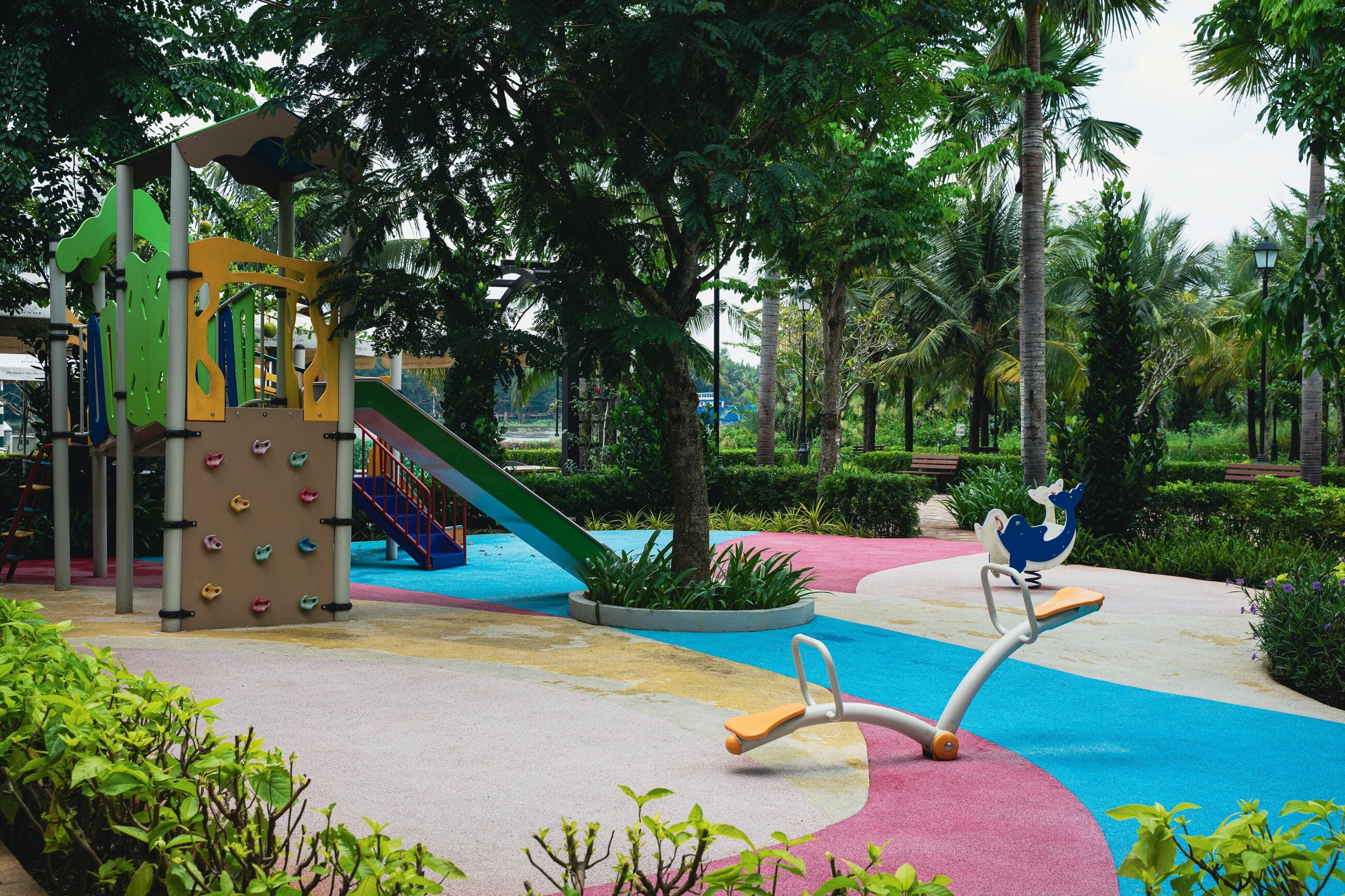
How many accessible play components does a playground need?
Three rules stack: one of each ground-level type must be on an accessible route, at least half of the elevated components must be on an accessible route, and Table 240.2.1.2 adds more ground-level components as the elevated count rises.
| Elevated components provided | Ground-level components on accessible route | Different types required |
|---|---|---|
| 1 | Not required | Not required |
| 2 to 4 | 1 | 1 |
| 5 to 7 | 2 | 2 |
| 8 to 10 | 3 | 3 |
| 11 to 13 | 4 | 3 |
| 14 to 16 | 5 | 3 |
| 17 to 19 | 6 | 3 |
| 20 to 22 | 7 | 4 |
| 23 to 25 | 8 | 4 |
| 26 and over | 8, plus 1 per 3 over 25 | 5 |
There is one shortcut. If at least 50 percent of the elevated components are connected by ramp, and at least 3 of those ramped components are different types, you do not have to meet Table 240.2.1.2 at all.
Counted ground-level components must also be spread through the play area, not lined up in one corner.
Worked example: a 9-component school structure
A school structure has 9 elevated components. The table requires 3 accessible ground-level components of 3 different types, for example a swing with an adaptive seat, a spring rider and a play panel. At least 5 of the 9 elevated components must also be on an accessible route, and below 20, a transfer system can provide it.
Worked example: a 22-component park structure
A park structure has 22 elevated components. The table requires 7 accessible ground-level components of 4 different types. At least 11 elevated components must be on an accessible route, and because the count is 20 or more, no more than 25 percent (5 components) can be reached by transfer system alone. That leaves at least 6 that must be reached by ramp.
What does an accessible route to a playground need?
An accessible route is a continuous, firm path a wheelchair user can travel from the site's arrival point to and around the play components, and on the ground it needs 60 inches of clear width and a running slope no steeper than 1:16.
- Width: 60 inches on ground-level routes. Play areas under 1,000 square feet may use 44 inches if a turning space is provided where that narrower route runs longer than 30 feet. A route may also narrow to 36 inches for up to 60 inches of length, for example around a tree.
- Slope: 1:16 maximum running slope on ground-level routes inside the play area.
- Headroom: 80 inches clear above ground-level routes.
- Swings: a wheelchair turning space must sit immediately next to any accessible swing.
The route also has to connect to accessible parking, a sidewalk or the building entrance. Someone in a wheelchair has to get from the car to the ramp, not just up it.
The two failures we see constantly
- Surfacing budgeted under the structure only. The route from the sidewalk gets grass, gravel or nothing, and the playground is not accessible, whatever the equipment does.
- A curb, step or border lip on the route. A 9 or 12 inch border timber around loose fill is a wall to a wheelchair. Ramped or flush transitions are cheap when designed in and expensive when retrofitted.

Border ramps for every common timber height are in our playground borders collection, priced and ready to ship.
Ramps or transfer systems: which does a playground need?
Below 20 elevated components, a transfer system alone can satisfy the elevated route requirement. At 20 or more, ramps must carry at least half of what the route covers.
What a transfer system is
A transfer system is a platform at seat height, with steps up to the deck, that lets a child move out of a wheelchair and climb onto the structure under their own strength. Under section 1008.3, transfer platforms must be 11 to 18 inches high and at least 24 inches wide by 14 inches deep, transfer steps can rise no more than 8 inches each, and both need at least one transfer support to grab.
What an elevated ramp needs
Ramps on a composite structure run at 1:12 maximum slope, rise no more than 12 inches per run, and need 36 inches of clear width and handrails on both sides. Reaching a 48 inch deck takes four 12 foot runs plus landings, which is why ramped structures cost more and use more footprint.
Compliant is not the same as usable
A transfer system counts. It also assumes upper body strength many wheelchair users do not have, and it means leaving the chair at the bottom while everyone else plays above. A ramp is the difference between a child being technically accommodated and actually playing with friends, and inclusive play funders know the difference.
What is the best accessible playground surface?
The best accessible playground surface is a unitary one, such as poured-in-place rubber or rubber tiles, on the route and at the main access points, because it stays firm and stable with little maintenance.
Two ASTM standards apply. Routes, clear floor spaces and turning spaces must meet ASTM F1951, which tests wheelchair mobility across the surface. Use zones must also meet ASTM F1292 for impact attenuation at the equipment's fall height. Section 1008.2.6 also requires regular inspection and maintenance, the part people forget.
The loose fill trap
Engineered wood fiber tests as accessible when installed and maintained at depth. A couple of seasons without raking and it compacts unevenly, migrates away from slide exits and swing pits, and stops being firm. Sand and loose rubber mulch are worse. The playground passed on installation day and fails now.
The hybrid answer
On most budgets the answer is unitary surfacing on the route and high traffic landing points, with engineered wood fiber across the rest of the use zone. It costs a fraction of wall-to-wall poured rubber and keeps the route accessible on a wet March morning. In New England, plan for frost too: loose fill freezes, and plows chew up poured rubber edges if the route doubles as a winter path.
We quote and specify surfacing with each project rather than selling it off the shelf. Our playground surfacing comparison and engineered wood fiber guide cover cost and upkeep in detail.
Accessible vs inclusive playground equipment
Accessible playground equipment meets the ADA minimums, while inclusive playground equipment is chosen so children with different physical, sensory and social needs can play together.
Inclusive design adds things the standards do not require: ramps instead of transfer systems, adaptive swing seats, ground-level spinners a wheelchair can roll onto, quieter spaces for children who get overwhelmed, and play panels at seated reach height. The ADA advisory reach ranges help here: 20 to 36 inches for ages 3 and 4, 18 to 40 inches for ages 5 to 8, and 16 to 44 inches for ages 9 to 12.
A simple first step for an existing swing set is an adaptive swing seat with chains for an 8 foot top rail at $1,091.85, with a turning space and accessible surface next to it. Browse the full inclusive play collection for ramps and accessible components.

Do age groups need separate play areas?
Yes: the CPSC Public Playground Safety Handbook recommends separating equipment for ages 2 to 5 from equipment for ages 5 to 12, with a buffer such as benches or planting. A toddler structure inside a school-age structure's use zone will be flagged in any inspection, and under the ADA each age area needs its own accessible route and component count.
A six point ADA check for any playground
- Count elevated components across the whole play area and check ground-level components and types against Table 240.2.1.2.
- Confirm half the elevated components are on an accessible route, with enough ramped at 20 or more.
- Walk the route from the nearest accessible parking space. Could you push a wheelchair the whole way?
- Check every transition for lips, steps and curbs, especially at the border.
- Push a ruler into the surfacing at four points on the route and in the use zone.
- Confirm the accessible ground-level components are different types and spread out.
Frequently asked questions
Does the ADA apply to playgrounds?
Yes. Newly built and altered play areas for children ages 2 and over at schools, parks, child care centers and other covered facilities must meet sections 240 and 1008 of the 2010 ADA Standards for Accessible Design. The play area rules do not apply to family child care run in the owner's home, amusement attractions or religious entities, although many church projects follow them anyway.
How many accessible play components does a playground need?
At least one of each type of ground-level component must be on an accessible route, and at least 50 percent of elevated components must be too. Table 240.2.1.2 then adds ground-level components based on the elevated count, from 1 extra for 2 to 4 elevated components up to 8 extra, of 5 different types, at 26 or more.
Is a transfer station enough for ADA compliance?
On structures with fewer than 20 elevated components, a transfer system can be the only way onto the deck and still comply. At 20 or more elevated components, no more than 25 percent may be connected by transfer systems, so the rest of the required half must be reached by ramp. Compliant and genuinely usable are not always the same thing.
Is engineered wood fiber ADA accessible?
Engineered wood fiber can pass the ASTM F1951 accessibility test when it is installed to depth and kept compacted, level and topped up. It loses that quickly when it is not raked, when it migrates out of high traffic spots, or when it freezes. Most budgets get a better result with unitary surfacing on the route and wood fiber elsewhere.
What is the difference between accessible and inclusive playground equipment?
Accessible playground equipment meets the minimums in the 2010 ADA Standards: enough components on an accessible route, reachable by ramp or transfer system, over a firm and stable surface. Inclusive playground equipment goes further, so children with different physical, sensory and social needs can play together, using ramps over transfers, adaptive seats and quieter ground-level spaces.
Read the source, then send us the site
The rules are free to read. The Access Board's accessible play areas guide is plain language with illustrated counting examples. Read the source rather than a manufacturer's summary of it, including ours.
When you are ready, send us your site and component list and we will tell you plainly whether a configuration clears the requirement, and what the route and surfacing will cost on top. Our playground safety standards overview covers the ASTM and CPSC side, and the playground layout guide shows where the route fits in the plan.
- CPSC Public Playground Safety Handbook, Publication 325
- United States Access Board, guide to the play areas requirements
- ASTM F1487, safety performance specification for playground equipment
- ADA and ABA accessibility guidelines, section 1008 play areas
- IPEMA product certification register
Cost figures are PlayGrove planning estimates based on current manufacturer pricing and installed project costs in the United States. They are budgeting ranges, not quotes. Standards are revised periodically, so check the current revision before specifying.
Turn this into a number you can take to a board
Send the dimensions, the age ranges and the ZIP code. You get one firm all-in proposal covering equipment, freight, surfacing and installation, written to be read by people who were not in the meeting.
A quote costs nothing and commits you to nothing. If you are early and just need a credible number for a grant application, that is a perfectly good reason to ask.