How Much Does a Commercial Playground Cost?
Real numbers for commercial playground cost: all-in ranges by project type, the budget split, catalog prices and three worked budgets.
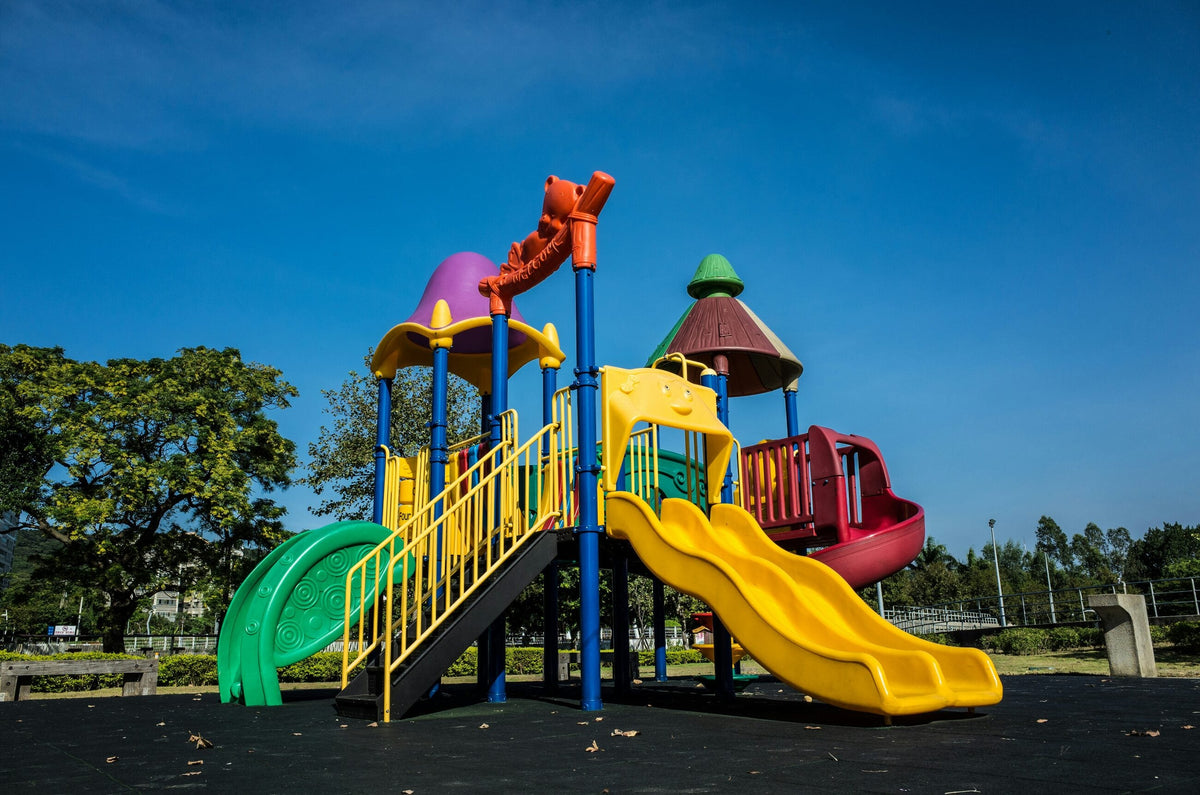
A commercial playground costs $25,000 to $60,000 for a small preschool or toddler yard, $60,000 to $150,000 for a typical school playground, and $150,000 to $350,000 or more for a municipal park, all in with surfacing and installation. The equipment itself is usually only 50 to 65 percent of that total. Below are the numbers you can take to a board meeting, real prices from our catalog, and the costs that push projects over budget.
TL;DR
- Plan on $25,000 to $60,000 all in for a preschool yard, $60,000 to $150,000 for a school playground, and $150,000 to $350,000 for a two-age park playground.
- Equipment is 50 to 65 percent of the installed cost. Divide your equipment quote by 0.55 to get a realistic all-in budget.
- Safety surfacing and installation each add 15 to 25 percent, freight adds 5 to 10 percent, and a 10 percent contingency is not optional.
- Our complete play structures run from $8,865.40 for a small ages 2 to 12 unit to $76,239.40 for a large shaded ages 5 to 12 system.
- The biggest savings come from phasing, choosing surfacing that matches your maintenance staff, and buying off a cooperative contract, not from cheaper equipment.

How much does a commercial playground cost?
For a typical outdoor commercial playground on a flat, prepared site, the all-in cost falls into four bands depending on who it serves and how many children use it at once.
| Project | All-in total | Equipment portion |
|---|---|---|
| Toddler or preschool yard, one age group | $25,000 to $60,000 | $14,000 to $34,000 |
| School playground, one age band, moderate capacity | $60,000 to $150,000 | $34,000 to $85,000 |
| Municipal park structure, two age groups | $150,000 to $350,000 | $85,000 to $200,000 |
| Destination or signature inclusive installation | $350,000 and up | $200,000 and up |
These are planning figures. They let you walk into a meeting with a defensible number instead of a guess, and tell at a glance whether a supplier's quote is in the right range.
What percentage of a playground budget is equipment?
Equipment is usually between half and two thirds of what a playground costs to put in the ground.
This single fact causes more budget failures than anything else in the category. Someone gets an equipment quote for $80,000, presents $80,000 to a board, and then discovers surfacing, freight and installation. Now the project is short by $40,000 or more, or it gets value-engineered into something nobody wanted.
Here is the working split, shown on a $100,000 project:
| Cost line | Share of total | On a $100,000 project | What drives it |
|---|---|---|---|
| Equipment | 50 to 65% | $50,000 to $65,000 | Capacity, deck height, inclusive components |
| Safety surfacing | 15 to 25% | $15,000 to $25,000 | Critical fall height and use zone area |
| Installation | 15 to 25% | $15,000 to $25,000 | Footings, assembly, soil and access |
| Freight | 5 to 10% | $5,000 to $10,000 | System size and delivery address |
| Site preparation | 0 to 20% | $0 to $20,000 | Demolition, grading, drainage, retaining edges |
| Contingency | 10% | $10,000 | Rock, buried debris, change orders |
The ranges overlap on purpose: a flat, open site with good truck access sits at the low end of every line, and a site with old equipment to remove sits at the high end. A quick rule: divide your equipment number by 0.55 to get a realistic all-in budget, or by 0.65 if the site is flat, clear and accessible.
How much does commercial playground equipment cost?
Commercial playground equipment costs about $9,000 to $80,000 for a complete play structure, $1,500 to $7,500 for a commercial swing set, and a few hundred to a few thousand dollars for standalone climbers, spring riders and site pieces. These are current prices from our catalog, already 5 percent below MSRP:
| Item | Ages | Our price |
|---|---|---|
| Quick-Ship Commercial Play Structure #1 | 2 to 12 | $8,865.40 |
| Totville Preschool Play Structure | 2 to 5 | $15,092.34 |
| Compass Commercial Play Structure | 5 to 12 | $34,198.74 |
| Thunder Island Play Structure with Shade Canopy | 5 to 12 | $55,372.34 |
| Commercial Play Structure with Shade Canopy (Model 35732) | 5 to 12 | $76,239.40 |
| Commercial Bi-Pod Swing Set, 2 Bay | All | $2,691.66 |
| Commercial Arch Swing Set, 4 Bay | All | $7,384.66 |
| ADA Adaptive Swing Seat with Chains, 8' Top Rail | 5 to 12 | $1,091.85 |
| Commercial Pyramid Shade Structure, 20' x 20' | All | $9,055.40 |
| 16' Commercial GaGa Ball Pit | All | $1,235.00 |
The full range of structures, with dimensions and capacity, is in our play systems collection.

Three worked playground budgets
The fastest way to see how the split works is to price real projects. Each example below uses current catalog prices, then applies the 50 to 65 percent equipment rule to estimate the installed total.
Church or daycare preschool yard
- Totville Preschool Play Structure, ages 2 to 5: $15,092.34
- Commercial Pyramid Shade Structure, 10' x 10': $5,731.66
- Equipment subtotal: $20,824.00
- Estimated all-in: $32,000 to $38,000
Elementary school playground, ages 5 to 12
- Compass Commercial Play Structure: $34,198.74
- Commercial Arch Swing Set, 4 Bay: $7,384.66
- ADA Adaptive Swing Seat: $1,091.85
- 16' Commercial GaGa Ball Pit: $1,235.00
- Equipment subtotal: $43,910.25
- Estimated all-in: $67,500 to $80,000
Town park with two age areas
- Commercial Play Structure with Shade Canopy (Model 35732), ages 5 to 12: $76,239.40
- Totville Preschool Play Structure, ages 2 to 5: $15,092.34
- Commercial Arch Swing Set, 4 Bay: $7,384.66
- Commercial Bird Nest Swing Set, 2 Bay: $5,065.40
- Commercial Pyramid Shade Structure, 20' x 20': $9,055.40
- Equipment subtotal: $112,837.20
- Estimated all-in: $174,000 to $205,000
What drives the equipment price?
Equipment price is driven mainly by how many children a structure serves at once, how high the decks are, and how many accessible and inclusive components it includes.
Capacity, not size
Manufacturers price around play capacity. A system for 46 children costs roughly twice one for 23, regardless of how tall it looks in the render. Work out your peak simultaneous use first. Specifying for your whole enrollment when only one class goes out at a time wastes money.
Deck height
Higher decks mean more structural steel, more guardrails and a higher critical fall height, which pushes surfacing cost up too. Height is the most expensive thing you can add and often the least useful.
Age range
Serving ages 2 to 5 and 5 to 12 on one site means two separate structures with separate use zones, not one bigger structure. The CPSC Public Playground Safety Handbook recommends separating play areas by age group, so combining them is a safety and compliance problem as well as a cost one.
Inclusive components
A fully ramped structure costs meaningfully more than one with a transfer station, because ramps are long, structural and take up footprint. Ramps are also the difference between technically compliant and genuinely usable under the 2010 ADA Standards for Accessible Design, and they open up inclusive play funding that standard equipment does not qualify for.
Material
Powder-coated steel and commercial-grade HDPE cost more up front than lighter alternatives and last much longer in freeze-thaw climates like New England. Our structures are built to ASTM F1487, the standard consumer safety performance specification for public playground equipment. Warranty is a good proxy for build quality: we cover steel uprights, clamps and stainless hardware for life, and metal decks, rails and rotomolded parts for 15 years. Over a 20-year life, the cheaper product is usually the more expensive one.
How much does playground surfacing add?
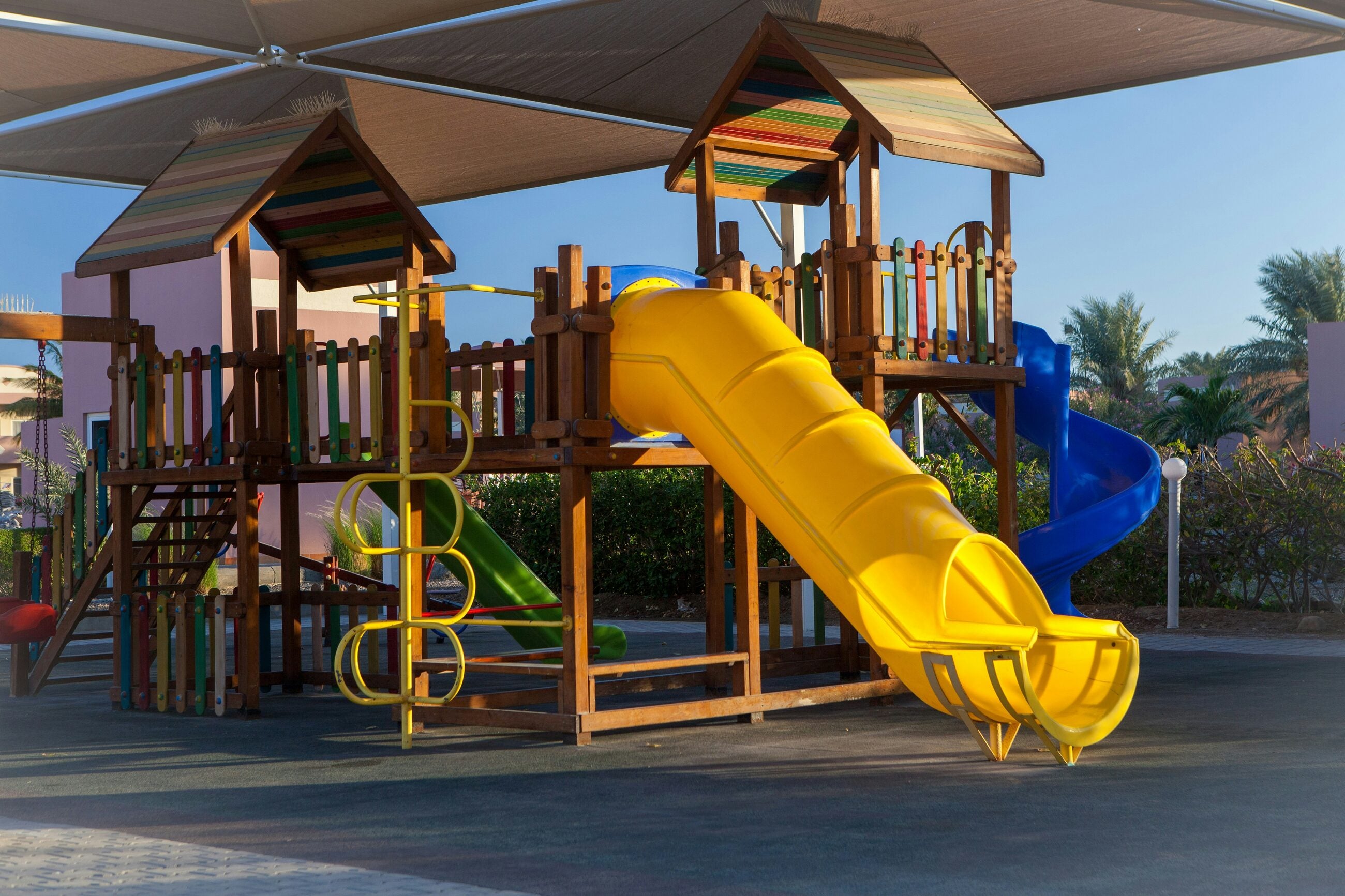
Safety surfacing typically adds 15 to 25 percent to the total project cost, and the amount depends on the use zone area and the critical fall height, not on how big the structure is.
The use zone is the area under and around equipment that needs protective surfacing. CPSC guidance calls for at least 6 feet in all directions around stationary equipment, and swings need more: twice the height of the pivot point in front and behind. Surfacing must also be tested to ASTM F1292 for the fall height of your tallest piece.
A worked example: a structure with a 30' x 20' footprint plus a 6' use zone on every side needs surfacing over 42' x 32', or 1,344 square feet. Engineered wood fiber, which should meet ASTM F2075, is installed at about 12 inches deep and compresses to around 9 inches. At 12 inches, 1,344 square feet is 1,344 cubic feet, or roughly 50 cubic yards before border timbers and drainage fabric.
Loose fill is cheaper to install and more expensive to maintain. Poured rubber and tiles cost far more up front and less to keep in compliance. We quote and specify surfacing with each project; our playground surfacing options compared guide covers the tradeoffs in detail.
How much does playground installation cost?
Playground installation usually costs 15 to 25 percent of the total project, which works out to roughly 25 to 50 percent of the equipment price.
Installation covers layout, digging and pouring footings, assembling the structure and checking it against the manufacturer's drawings. Price moves with soil conditions, access for equipment, and the number of footings. In New England, rock or ledge found while digging footings is the most common change order, so ask how your installer prices it before you sign.
See our playground installation page for how we handle it.
The seven costs people forget
- Removing what is already there. Old equipment, old surfacing and disposal.
- The accessible route. An accessible surface has to reach the equipment from an accessible path. Budgeting for surfacing under the structure but not for the route to it is the single most common miss we see.
- Border and drainage. Loose fill needs containment and somewhere for water to go. Our 12" border timbers are $37 each, and an ADA border ramp is $885.40. Poured surfacing needs a proper base.
- Shade. Rarely in the first budget, almost always wanted by year two, and much cheaper installed with everything else. A 20' x 20' pyramid shade is $9,055.40.
- Site amenities. Benches, tables, receptacles and a bike rack.
- Inspection and maintenance. An annual inspection and a parts budget. Loose fill needs topping up, and surfacing compacted below depth is a compliance problem as well as a safety one.
- Signage. Required in many jurisdictions, cheap, and invisible until someone asks for it.
Where are the real savings on a playground?
The real savings on a playground come from how you plan and buy the project, not from choosing cheaper equipment.
- Phase it. Buy the structure now, add shade, amenities and the second age group next year.
- Choose surfacing deliberately. Engineered wood fiber is far cheaper to install than poured rubber and more expensive to maintain. Which wins depends on whether you have maintenance staff.
- Buy off a cooperative contract. Ask us which contracts cover the equipment you want. Using one costs nothing, satisfies competitive procurement rules for most public buyers, and can remove three to six months from the timeline. See cooperative purchasing for how it works.
- Install outside peak season. Installer availability is tightest in late spring. Ask what a September install saves.

Grants and donations can offset part of the total too. Our guide to grants for playground equipment covers where the money is and how to write the application.
Frequently asked questions
How much does a playground cost for a school?
Most school playgrounds cost $60,000 to $150,000 all in for one age band with moderate capacity. That includes equipment, safety surfacing, freight and installation. An elementary school serving ages 5 to 12 with a mid-size structure, a four-bay swing set and a gaga pit typically lands around $67,000 to $80,000 installed. Adding a separate preschool area or a large shaded structure pushes the total higher.
How much does playground installation cost?
Installation usually runs 15 to 25 percent of the total project cost, or roughly 25 to 50 percent of the equipment price. The number depends on soil conditions, how many footings the structure needs, site access for machinery, and whether rock or ledge turns up while digging. Get installation quoted with the equipment so the price reflects your actual site and ZIP code.
Why is commercial playground equipment so expensive?
Commercial equipment is built for decades of public use. It uses heavy-gauge powder-coated steel, commercial HDPE and stainless hardware, and is designed to meet ASTM F1487 and CPSC guidance for public play. It also carries long warranties, often lifetime on steel uprights and 15 years on decks and rails. Residential sets are cheaper because they are not built or tested for that level of use.
How much does a small commercial playground cost?
A small commercial playground for a daycare, church or preschool typically costs $25,000 to $60,000 installed. For example, a Totville preschool structure at $15,092.34 plus a 10' x 10' shade at $5,731.66 comes to $20,824 in equipment, which works out to roughly $32,000 to $38,000 once surfacing, freight and installation are added.
How long does commercial playground equipment last?
Well-built commercial playground equipment commonly lasts 15 to 20 years or more with regular inspection and maintenance. Steel uprights and hardware often outlast plastic components, which is why warranties are split by part: our steel uprights, clamps and stainless hardware carry a lifetime warranty, metal decks and rotomolded parts 15 years, and HDPE panels 5 years.
Can a public school or town buy playground equipment without going out to bid?
In most cases, yes. Buying through a cooperative purchasing contract such as Sourcewell or OMNIA Partners satisfies competitive procurement requirements for many public agencies because the contract was already competitively solicited. Check your own procurement policy first, but this route commonly saves three to six months compared with a formal bid.
Get a number you can rely on
Five things turn a range into a firm price: the dimensions of the space in feet, the age ranges you need to serve, the ZIP code the truck delivers to, your rough budget, and how you plan to pay. Send those and we will come back within 24 hours with one all-in figure covering equipment, freight, surfacing and installation.
Request a playground quote and get a total you can take to your board.
- CPSC Public Playground Safety Handbook, Publication 325
- United States Access Board, guide to the play areas requirements
- ASTM F1487, safety performance specification for playground equipment
- IPEMA product certification register
Cost figures are PlayGrove planning estimates based on current manufacturer pricing and installed project costs in the United States. They are budgeting ranges, not quotes. Standards are revised periodically, so check the current revision before specifying.
Turn this into a number you can take to a board
Send the dimensions, the age ranges and the ZIP code. You get one firm all-in proposal covering equipment, freight, surfacing and installation, written to be read by people who were not in the meeting.
A quote costs nothing and commits you to nothing. If you are early and just need a credible number for a grant application, that is a perfectly good reason to ask.